
Why Every Home Purchase Offer Today Should Include At Least 2% Seller Credit
Key Takeaways
- A seller credit of at least 2% of the purchase price will cover the cost of most 2-1 buydown programs for buyers in Bozeman, the Gallatin Valley, and the greater Montana area.
- On a $500,000 home with 5% down at 7.5%, a 2-1 buydown lowers the buyer’s payment by about $624 a month in year one and $319 a month in year two.
- Buydown funds are held in escrow and used month by month. They aren’t spent at closing like discount points.
- If rates fall and the buyer refinances, unused buydown funds are applied to the loan payoff and can allow for a future permanent rate buydown.
- Buyers still qualify at the full note rate, so sellers get a fully qualified buyer.
Your buyer has found the right $500,000 home. They have their 5% down payment ready and are approved. Then they see the monthly payment at a 7.5% mortgage rate, and suddenly they aren’t sure.
This happens every day right now, from Miles City, through Bozeman, and all the way to Kalispell. Buyers can afford the house, but the payment shock is hard to live with, and they worry about locking in at a high rate. Agents can ease a lot of that worry with one line in the purchase contract: a seller concession credit of at least 2% of the purchase price.
When that seller credit pays for a temporary 2-1 buydown, the buyer gets a much lower payment right away, has a clear path to the full payment, and keeps options open for a beneficial refinance if rates come down. The seller gets a stronger, more confident buyer without cutting the list price significantly.
A Price Cut Isn’t the Best Ask
When rates spike, the usual move is to ask for a lower price to soften the payment shock. But a $10,000 price cut on a 7.5% loan lowers the monthly payment by only about $66. The same $10,000 put toward a 2-1 buydown can lower the buyer’s payment by more than $600 a month in the first year.
Sellers often prefer this too. The contract price can stay close to where it is, which protects their comparable sales and how the listing looks, and the money works much harder for the buyer. In a market like the Gallatin Valley, where home values matter to every neighbor on the street, that’s a better use of the same dollars for both sides.
How a 2-1 Buydown Works
A 2-1 buydown lowers the buyer’s rate for the first two years:
- Year 1: payment based on 2% below the note rate (5.5% when rates are 7.5%)
- Year 2: payment based on 1% below the note rate (6.5%)
- Years 3–30: full payment at the note rate (7.5%)
The loan itself is written at the market rate the whole time. At closing, the seller credit that pays for the buydown goes into an escrow account. Each month the buyer makes the lower payment, and the servicer takes the difference out of escrow so the investor gets the full payment. The account goes down month by month until the two years are over.
This is the key point: the money isn’t spent at closing. It’s set aside and used month by month. That matters a lot, as you’ll see below.
The $500,000 Example
A buyer purchases a Montana single-family residence, townhouse, or condo, puts 5% down ($25,000) and takes out a $475,000, 30-year fixed loan at 7.5%. Here is what principal and interest look like:
| Period | Rate Paid | Buyer’s Monthly P&I | Paid From Escrow |
|---|---|---|---|
| Year 1 | 5.5% | $2,697 | $624 |
| Year 2 | 6.5% | $3,002 | $319 |
| Years 3–30 | 7.5% | $3,321 | $0 |
Illustrated
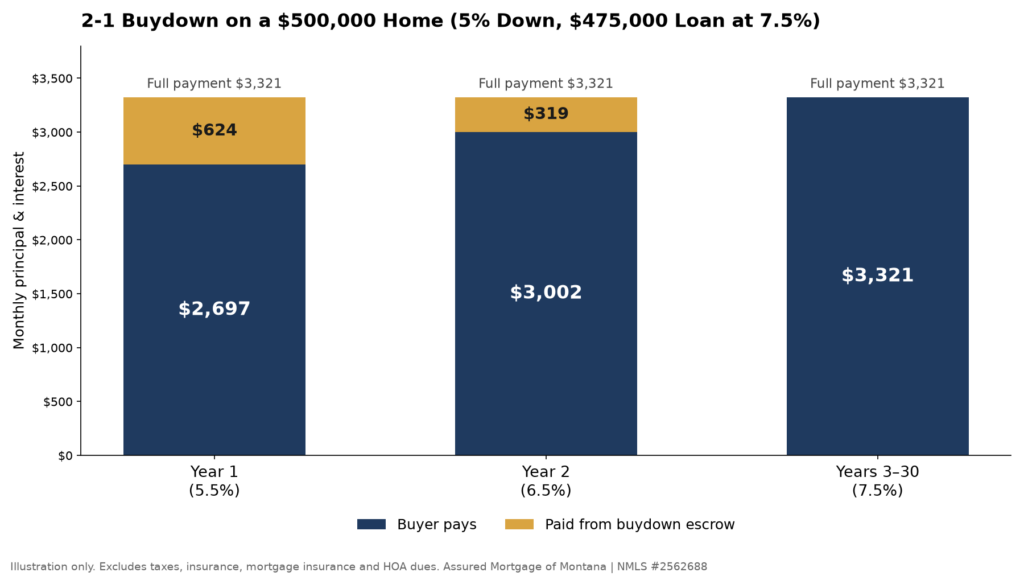
That’s $624 a month back in the buyer’s pocket in year one and $319 a month in year two, or about $11,300 over two years. The payment in year one is about what the buyer would pay if rates were back at 5.5%.
The cost depends on a mix of the home price, loan amount, and loan to value percentage. On this home it ranges from about 1.4% of the price with 40% down to about 2.3% with 5% down. That’s why 2% is the right minimum to ask for. This credit covers the cost of most 2-1 buydown programs, but not all. As well, if any credit is left over, it can go toward the buyer’s other eligible closing costs. For low-down-payment buyers, ask for more than 2% when the loan program allows it.
Taxes, insurance, mortgage insurance, and HOA dues are separate and not included above.
The Advantage Most People Miss: Leftover Money Still Counts
This is where a temporary buydown beats a permanent one.
With a permanent buydown, the buyer pays discount points at closing for a lower rate for the life of the loan. That money is gone the day the loan closes. If rates drop a year later and the buyer refinances, the points they paid do nothing more for them. They paid for 30 years of savings and used only one.
With a 2-1 temporary buydown, the money sits in escrow and is used a month at a time. In our example, about $7,500 is used in year one, leaving about $3,800 still in the account heading into year two.
So if rates fall during the buydown period and the buyer refinances, that money isn’t wasted. Under most buydown agreements, including those following Fannie Mae and VA guidelines, the remaining escrow balance is applied to the loan payoff. A smaller payoff means a smaller new loan or less cash needed to close. That savings can even help pay for a permanent rate buydown on the new loan, so the buyer gets a lower rate for good.
Here’s the full picture for your buyer:
- If rates drop: they refinance, the unused buydown money lowers their payoff, and they can put that value toward a lower permanent rate.
- If rates stay flat or go up: they keep their fixed-rate loan, get the full two years of lower payments, and move to a payment they already qualified for.
The buyer comes out ahead either way. A permanent buydown bought at today’s rates can’t offer that.
Why This Works for Every Loan Type
Temporary buydowns aren’t a niche product. 3-2-1, 2-1, and other buydown options are available on Conventional, FHA, and VA purchase loans at major wholesale lenders, and on many Non-Qualified Mortgage (Non-QM) purchase programs, such as those for self-employed buyers. That covers a large share of Montana’s buyers, including business owners and seasonal workers. Seller-funded buydowns are widely accepted, and seller credit limits are generous enough to cover them in most cases:
- Conventional (Fannie Mae Selling Guide): 3% above 90% LTV, 6% at 75–90% LTV, 9% at 75% LTV or below
- FHA: up to 6% of the sales price
- VA: a seller-funded buydown counts toward the 4% concession limit
- Non-QM: limits vary by lender and program
A 2% credit fits within the Conventional, FHA, and VA limits, which is why it works as a standard part of every financed offer.
Buyers Qualify at the Full Rate
This is the part that should reassure sellers, listing agents, and buyers alike. Buyers must qualify at the full payment, not the lower buydown payment. The buydown doesn’t stretch anyone into a home they can’t afford. It gives already-qualified buyers breathing room during the most expensive stretch of owning a home: moving, furnishing, repairs, and getting used to a new budget.
For listing agents, that means an offer with a buydown credit comes from a buyer who is fully qualified and more likely to feel comfortable, stay in the deal, and close.
What Agents Should Do Now
- Make a 2% minimum seller credit standard. Put it in every financed offer while rates stay high.
- Call the loan officer before you write the offer. Get the exact buydown cost for your buyer’s loan amount, and increase the credit if it’s needed and allowed.
- Word it flexibly. Direct the credit to “a temporary rate buydown and other eligible closing costs” so the buyer can use every dollar.
- Present it as a win for both sides. The seller keeps the price close to list, and the buyer gets a payment they can live with plus a way into a lower rate later.
- Show the numbers. A one-page payment schedule from the lender makes the case better than any explanation.
The Bottom Line
High rates don’t have to stop a sale. A 2% seller credit put toward a 2-1 buydown turns a hard monthly payment into a manageable one, protects the seller’s price, and protects the buyer’s money if rates fall. No other line in a purchase contract gives buyers this much relief and flexibility for the cost.
Make it standard in every offer. Whether you’re writing offers in Bozeman, Belgrade, Big Sky, or anywhere, call Assured Mortgage of Montana at 406-589-5464 before your next one, and we’ll run the exact numbers for your buyer.
About the Author
Gregory Klevenberg, NMLS #1286056, is a mortgage broker with Assured Mortgage of Montana. He has 25 years of lending experience serving buyers, sellers, and real estate agents throughout Western Montana, including Bozeman and the Gallatin Valley. Greg specializes in Conventional, FHA, VA, and Non-QM financing, including seller-funded buydown strategies. Reach him at 406-589-5464.
Assured Mortgage of Montana | Company NMLS #2562688 | Loan Originator Gregory Klevenberg, NMLS #1286056 | Equal Housing Opportunity. This article is for educational purposes only and is not a commitment to lend. Payment examples are illustrations based on the stated assumptions and exclude taxes, insurance, mortgage insurance, and HOA dues. Rates, terms, loan programs, seller contribution limits, and buydown availability are subject to change and depend on borrower qualification, property eligibility, and lender guidelines. Treatment of unused buydown funds is governed by the buydown agreement and loan program requirements.


